Welcome to Intaresu Live Sessions, our new series of live sets recorded on video. Each episode puts one artist and their setup in the spotlight, whether that’s a table full of hardware, a laptop with MIDI controllers, or anything in between.
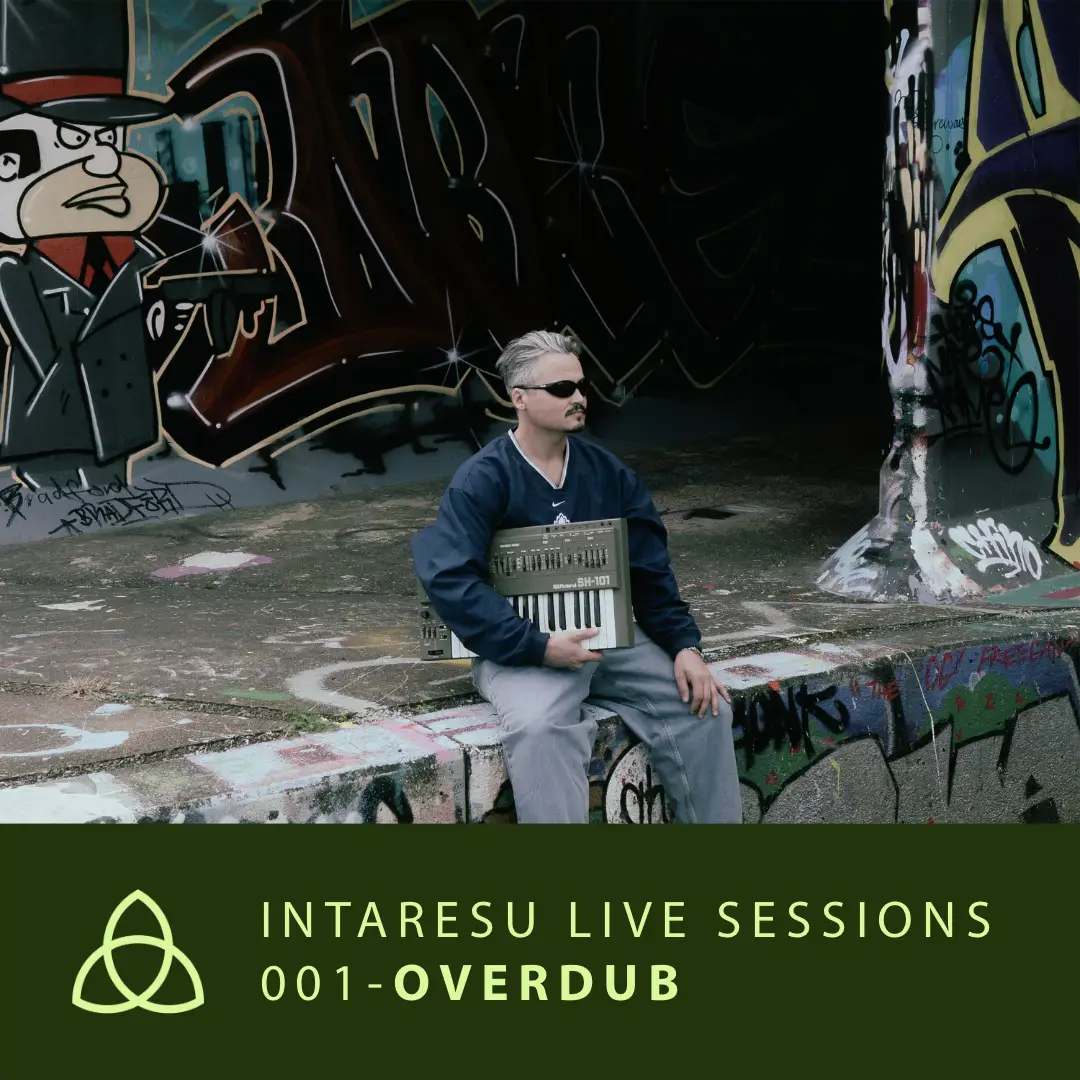
We’re opening the series with Overdub, the new alias of the artist behind Microminimal Records. For this session he recorded his performance live to cassette on a 1986 Tascam Porta Two, using vintage Japanese Type II tapes from the early ’90s. His rig includes an MPC loaded with samples from his old TR-707, an original SH-101, a Dreadbox Hades and Erebus, a modified MB-33 and a Nymphes, all running through delay and reverb pedals and a Polivoks filter.
Every track is unreleased and was made just for these recordings. They are acid house pieces he has been playing live since 2019, reworked through the minimal, dubby lens of early house and techno.
We spoke with him about working within the limits of tape, why he has almost stopped DJing, and the artists who shaped his sound.
1. Can you walk us through your setup for this session?
My drums are MPC samples cut from my old Roland TR-707. I ran these through a Boss KM-6A and SSL Bus Compressor for crunch and presence. The bass interplay comes from a Dreadbox Hades and an original SH-101, with no processing on either. The acid tones come from a modified MB-33 running into a Chroma Console multi-effects pedal, which is my favourite pedal by a long way.
The dubby stabs and chords come from a Dreadbox Erebus, my favourite synth, and a Nymphes, both running into a variety of delay and reverb pedals. I then send these into my Elta Music Polivoks analogue filter, giving me tonal control at the source through each synth’s internal VCFs, followed by the Polivoks at the end of the chain.
I then recorded the performances live to cassette, with no processing aside from the mixer’s EQs and the tape’s compression, followed by an Ableton True Peak Limiter.
2. Which piece of gear is the heart of your current live set, and why?
The centrepiece of my new Overdub project is my 1986 Tascam Porta Two mixer and cassette deck.
Modern technology offers finished tracks at the click of a button, unlimited digital recording and playback options, and a potentially infinite number of channels in a DAW mix. It may sound counterproductive, but I find I do things with more intent and focus when working on tape because it is so detached from that convenience.
Everything on cassette comes at a cost of time or expense. Usage over time introduces wear to the tape itself and the machine’s components. Playback on the mixer requires a mechanical rewind, and you also have to clean the tape heads and capstans between long takes.
3. How did you prepare this set?
I actually recorded six cassettes’ worth of live tracks in one day a few weeks ago. My Overdub alias feels like I have turned a page in my sound, and I wanted to make the final recordings of the quite Acid House-forward performance pieces I have been writing and playing live since around 2019, but from this new Overdub perspective.
4. Are the tracks in this session released, unreleased, or made just for this recording?
They are unreleased and were made completely unique to these recordings. I wanted to try to write, record and process the audio as faithfully as possible to the raw techniques of the early days of House and Techno, when they were often minimal and dubby in nature.
Minimal by virtue of the limited number of tracks available to home recordists in the ’80s, and dubby through the influence of both Reggae Dub and Disco B-side and remix culture, which have influenced electronic music so greatly.
The mix is printed live onto vintage Japanese High Bias Type II cassettes from the early 1990s, and the machine is calibrated to the specific brand of tape. Organising all of that has been quite a learning curve over the last few months.
5. Do you see yourself in the future leaning more into live sets than DJing?
I have been getting into Frequency Modulation synthesis, which lends itself well to a more Dub-oriented sonic palette. These older projects rely on Analogue Subtractive Synthesis and a more Acid-forward style, but I thought it would be fun to perform them with this new outlook.
With the amount of piracy and AI imitation going on in the digital music space, I am drawn more and more to the imperfection and warmth of pre-internet approaches to recording live music. The human aspect of live performance is more important than ever now, and that is partly why I have almost entirely stopped DJing to focus on this.
6. Which artists or live acts shaped your approach to hardware?
“Dub” and “Minimal” take form as musical abstractions as much as genres. They are underpinned by a set of definitive aesthetic rules that are often borrowed and applied to other musical concepts. An example of this somewhat unique characteristic that Dub and Minimal share is that a Deep House track can simultaneously be described as “dubby” and “minimal” despite being neither in its entirety.
These two musical philosophies broadly explore the use of constraint, time-based and modulation-based effects, and the creation of largely non-instrumental or atonal soundscapes. These core live-mixing techniques lend themselves well to almost all forms of electronic music, which is why you can find dubby and minimal sub-genres of Drum and Bass, Electro, House, Techno and more.
I think getting my head around these core aspects has been key to shaping my sound, and for that I must largely thank my former tutor, Jason O’Bryan. He taught a class about the links between the origins of Dub culture, remixing and electronic music that really helped frame the premise of these recording sessions.
Asad Rizvi (Silverlining) was the first artist who got me into the Minimal House sound growing up, and he has had a profoundly formative effect on my development as a musician and audio engineer. I have had the privilege of getting to know him and watching him masterfully blend Acid, Dub and House records in person on several occasions – he always blows my mind.
7. What are you working on right now? Any upcoming releases or gigs?
I am going to New Zealand in a few weeks, where I will be recording live in the mountains with my new compact live setup: an Elektron Digitone Mk2 and Dreadbox Erebus, with a couple of pedals, running into my tape machine.
8. Where can people follow you or buy your music?
Bandcamp: https://microminimal.bandcamp.com
Instagram: @overdub.rj / @microminimalrecords
SoundCloud: @microminimalrecords